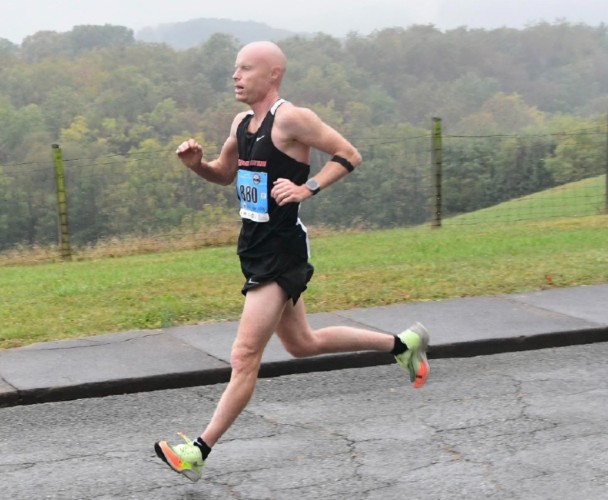
Now that CDR is over, it’s time to get down to work and get serious about a process I started a couple weeks ago. As I’ve discussed a few times recently, I’ve been taking a long, hard look at my training and the results it was getting me, and I’ve decided that changes are definitely in order. At the root of all those changes is a basic need to increase my ability to run fast.
At first, that might sound a little overly simple if not downright silly, right? After all, when race performance is your primary goal, isn’t increasing your ability to run fast always the key? Well, the answer to that, of course, is yes, but I’m taking it a step further. Looking at my races over the past year and a half, it didn’t really seem to matter what the course or conditions were or even how much good training I’d strung together leading up to the event; I ran about the same regardless. There seemed to be a governor or ceiling or whatever you want to call it around 5:30 pace and I just haven’t been able to break through that.
As I told Andrew the other day, it really hit home for me when he and I did 2X20 min at marathon pace in one of our recent long runs. My strength and endurance has always been my strong suit, and overall that run went pretty well. However, I started to struggle towards the end of the second push, and that was running a pace in the 6:05-6:10 range. As I thought about this, it was frustrating that even that pace could feel fast. Sure I wasn’t rested beforehand and we were an hour and 40 minutes into a run so I expected it to hurt, but still, I know how I felt and it wasn’t like I wanted. Certainly there was no way I could have held that pace for 26.2 miles if that had been the goal.
That got me to thinking. What makes marathon pace feel easy? Well, beyond the obvious answer of being strong and fit, it’s because your marathon pace is a harder effort, but not nearly as fast as say your 5k pace. To oversimplify matters greatly, as I know there are many more factors at play, if you can run a mile in 5 min flat, running one in 6 min flat will not feel that hard. If you can run one in 4:30, running one in 5:30 won’t feel that hard. In other words, to a great extent, your comfortably hard pace is a function of your really hard pace, and therein lies my problem. My 5k pace has been in the 5:30’s, even the upper end of that range for a while now, so running 6 flat is less than 30 seconds faster than that. Furthermore, my 5k pace isn’t that much faster than my full out effort for say a mile. In other words, my pace range is far too narrow at the moment.
Now, that doesn’t mean I can train like a sprinter and neglect everything else. As I said, there are many factors at play when it comes to running fast for long distances. However, the one I’ve neglected the most is the speed element. All other things equal (which they never are), the guy who can run the fastest 100m will run the fastest 200m, 400m, 800m, mile, etc. Again, there are many other things to consider like endurance, slow-twitch/fast-twitch muscle ratio, and on and on, but all things equal, the guy with the fastest top-end speed will be faster across the board. This is one of the reasons you saw Galen Rupp and Mo Farah working so hard on their raw speed this year, going so far as to work on flat out 100m sprints. Part of it was to develop the lethal kick that showed up in the Olympic 10k, but part of it was because being faster at a shorter distance leads to being faster at a longer one. Alberto Salazar has had his athletes race much shorter distances than their primary event for years. Why? Because getting faster at 800m will help your mile time and improving your mile time will help your 5k time and improving your 5k time will help your 10k time and … okay, you get the point.
So, there’s my basic goal. Again, you won’t see me training like a sprinter or even a miler. My slow-twitch to fast-twitch muscle fiber ratio is definitely overwhelmingly on the slow-twitch side, so there’s a limit to how much raw speed I can develop and how much it will help me. However, I can do A LOT of work on the mile to 5k end of things, and that will help the longer distances where my best performances might still be ahead of me. As silly as this may have sounded to me at one point in time, and probably still does to a lot of readers of this blog, one of my goals for this fall is to run a sub-5 minute mile. I honestly don’t remember the last time I did that, which is kind of sad, and I’m pretty sure that as of right now I can’t do it, which is even more sad in light of where I once was and eventually want to be. If I can get back to a point where I can run a mile in 4:50, then 5:15 at the start of a 5k won’t feel so darn fast like it does right now. Also, as I slip off the pace as the race wears on, that slip will start at a much higher point and therefore not get as slow as it does now. I’ve got endurance, strength, and the ability to grind on my side, but those skills do me no good whatsoever if every single faster pace I run feels hard/fast.
Anyway, that’s my theory at least. Now I have to put it into practice and see how the results turn out. Having neglected doing any significant amount of work at paces faster than 5:30/mile for so long means this isn’t going to be an easy process, nor will the results be immediate. I’m sure I’ll have to do plenty of suffering and endure quite a few disappointing to downright embarrassing performances along the way, but if the end result is what I’m seeking, it will all be worth it. There was a time when I thought the guy who ran the most miles always won. I’ve since learned that’s not always the case. It’s the guy who runs the most AND utilizes those miles the most effectively, covering all his bases along the way by working all the various systems important to distance running performance.
Time to do work!

No comments:
Post a Comment