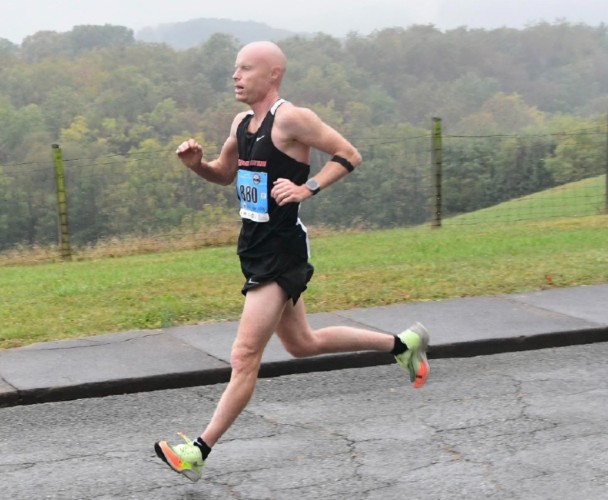
Below is part one of two posts I’m going to make on changes I’ll be incorporating into my training as I get back into things. The theme of both is “Less is more.” This post is a bit lengthy, but read on if you’re interested in lots of insight on my running career.
My friend and occasional training partner, Mike Cox, a two-time Olympic Trials qualifier in the marathon and a 13:54 5k runner, has a saying when it comes to training: “Less is more.” Like me, Mike has struggled with injuries over the years and has learned what works for him. He can’t log the big 120+ mile weeks that many marathoners do or he gets hurt, but he’s figured out how to balance decent volume (80-90 miles a week at peak) with a solid amount of quality to get himself as fit as possible while staying healthy.
Unfortunately, I don’t think I’ve ever been able to find this balance, but doing so is one of my chief goals going forward. Most of those who know me know I didn’t start running until my sophomore year of college, so I didn’t get the chance to develop a base throughout high school as most runners do nor did I have a clue about the best way to train for distance running. As a result, I never ran that much mileage in college (probably 40-45 miles/week average, maybe less) and my results were mediocre at best. After college, I wanted to improve, so I sought out guys who were much, much better than me, guys like Mike Cox, George Probst, Howard Nippert, Steve Taylor, and others, and not only got their advice but trained with them when I could. I can’t say how much I appreciate the help those guys have given me (and continue to give me), and without them, I wouldn’t have obtained the results I did, such as running well over 2 min faster for 5 miles than my college PR.
One thing I learned quickly from those guys is they were running WAY more mileage than I had ever even contemplated (or heard of or thought possible for that matter). As a result, I set out to run more, and run more I did. Not coincidentally, I started to get faster and faster. In fact, the more mileage I ran, the faster I got. I got to a point where I was logging 90-100 miles per week consistently and had many weeks over 100, going as high as 114. This was made all the better by the fact that 1) I’ve never liked speedwork because I have no natural speed and therefore not only does it hurt but I stink at it and 2) I have a natural propensity to want to outwork people in whatever I do. So, if I could improve by running lots and lots of mileage and not doing a lot in the way of track work, it would be an optimal situation.
At first I left track workouts and shorter fartlek workouts in my training routine and increased my overall mileage in addition. However, I found this left me tired (and I started to get hurt), so gradually I did less and less in the way of faster workouts and more and more in the way of longer tempos and just plain mileage. I continued to get faster, so I thought I had achieved what was an ultimate scenario for me, run lots of miles with just a few workouts and race fast by doing so.
There’s lots and lots that could be said about the time between then and now, but there’s no need to go into it. Fast forwarding to today, and many injuries later, I see what I did wrong. Increasing mileage wasn’t a mistake. I needed that and I still believe the more you can run without getting hurt the better (no such thing as “junk” miles in my book). My mistakes, however, were twofold. First, I skipped steps in my mileage build. I didn’t have periods of time where I averaged 60 miles a week, followed by a block at 70, followed by a while averaging 80, etc. Instead, I tried to go from averaging 50 per week straight to 80-90 and beyond. Second, I sacrificed my speed, and likely a lot of my form with it, by neglecting speed and turnover work. It was a double whammy that was a recipe for an injury riddled disaster, and that’s exactly what I got. Even the past couple years when Howard has been helping me with workouts, I haven’t followed what he has prescribed to the letter, favoring instead to do more than what was on the schedule and/or substituting workouts generally because I would be too tired to do what was written down or didn’t want to get on the track for various reasons (including knowing how much it would hurt and fear I’d find out just how slow I was).
Do I have regrets? Some, but not as many as you might think. I laid it on the line, did what I thought I needed to do, and ran a lot faster than I ever thought possible coming out of college. Would I make changes? Well, that’s the good part. I still have time to do that. Not starting my running career until college hurt me for a while, and being injured over the past several years has certainly been frustrating to say the least. However, I feel like both have given me the opportunity to extend my career beyond what I might have been able to do otherwise. Furthermore, this gives me the chance to learn from my mistakes and still set some PR’s over the next few years.
So, part one of two of the “Less Is More” series is less mileage and more quality. Again, I’m not going to become a low mileage runner. I don’t believe that’s the way to success. What I am going to do is be smarter and also have a much broader workout repertoire. No more skipping steps in mileage builds. No more adding on, especially on recovery days, just to fill up the log book. No more fearing the track and the shorter work I need for both speed and form. No more ignoring the need for down weeks here and there, and finally, no more never tapering for a race and not giving myself an opportunity to find out what I can do. Being older isn’t always a bad thing, particularly if you’re wiser and put that wisdom to use. I’m really excited about making some much needed changes, putting all this into practice, and seeing what happens. At the very least, it will make for a fun journey.
Part II to come.

2 comments:
I think I hear the RC track calling your name....
Absolutely, Steve, and I can't wait to answer that call!
Post a Comment